
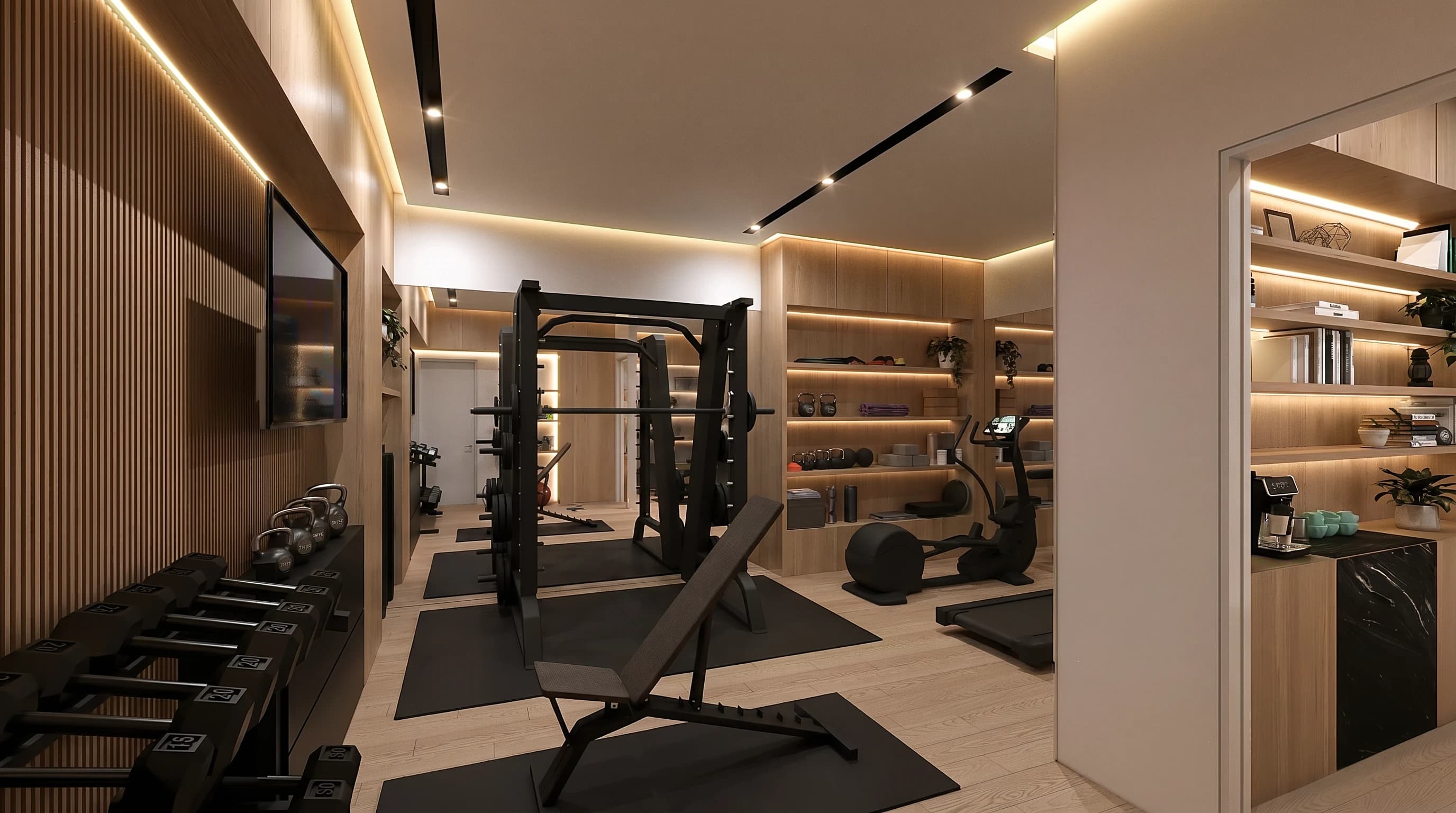
Converting a garage into a home gym and home office in California is a custom architecture project — typically beginning with an as-built survey ($1,000–$2,000), followed by schematic design with equipment test fits, then a complete drawing set with outline specifications before construction documents and permitting. This is a walk-through of one such design study we developed for a client in Newark, California — from the first site visit through the conceptual drawing package we delivered.
The Newark project at a glance
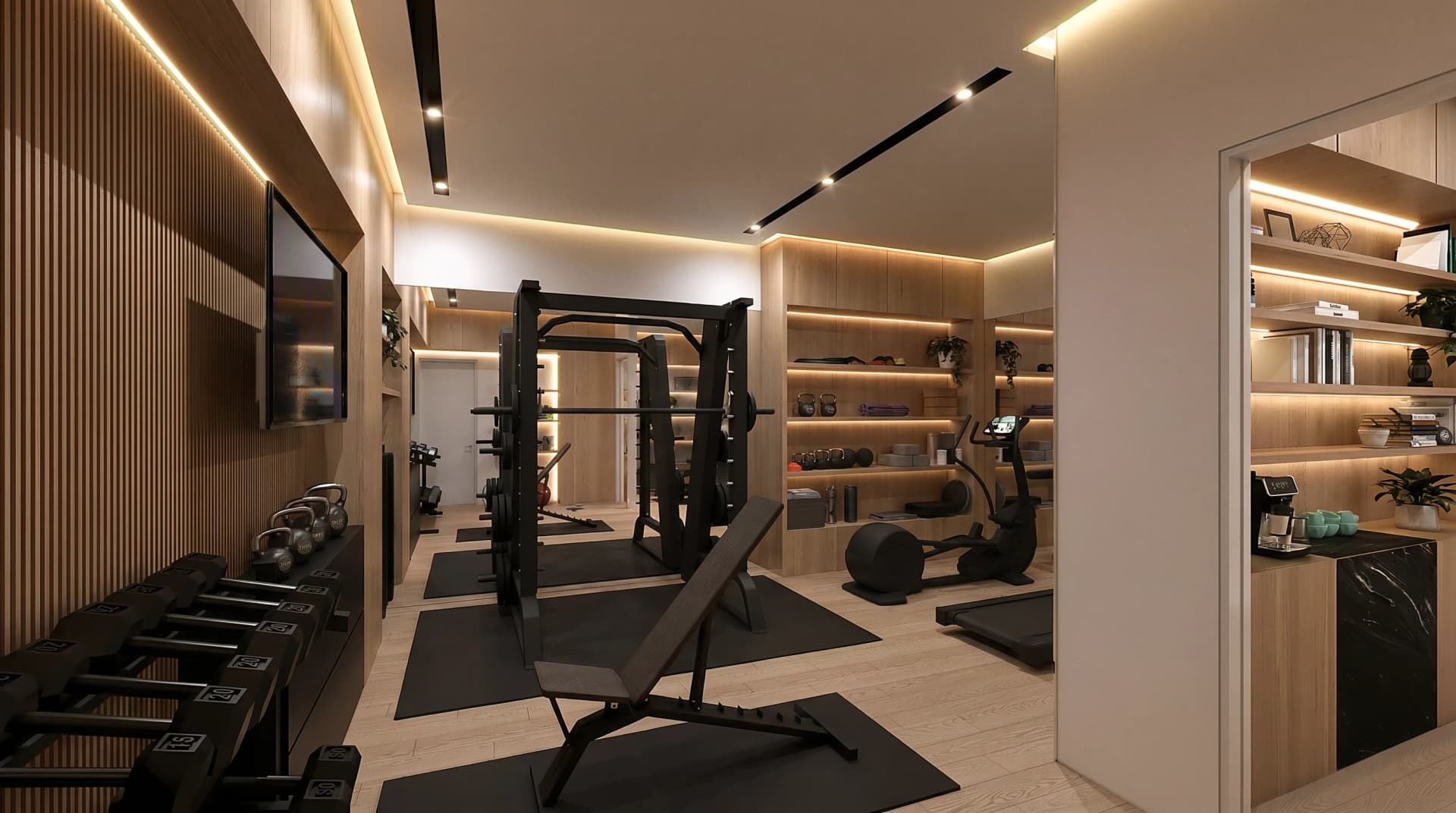
The project: a roughly 360-square-foot detached garage at 37612 Dockport Road in Newark, California — a Bay Area suburb in southern Alameda County. The owner wanted to convert the garage into a combined home gym, home office, and small yoga area. They had a specific equipment list in mind: a Smith machine, a weight rack, a treadmill, an elliptical, and a 65-inch TV for guided workouts. The office needed to function independently of the gym, with sound separation between the two.
Three things on the existing wall had to stay where they were: a water heater, the home’s electrical panel, and a water filter. Working around fixed utilities is one of the most common design constraints in garage conversions — they cluster on whichever wall connects most directly to the main house, and relocating them is expensive enough that the design has to flex around them, not the other way around.
Phase 1 — As-built survey ($1,500)
Every renovation project starts here. An as-built survey is a precise dimensional and condition record of the existing space, captured by physically measuring the building. For this project the survey ran $1,500. That price gets you a deliverable that includes:
- An existing floor plan accurate to within a quarter-inch
- A reflected ceiling plan showing existing fixtures, beams, and any height changes
- Interior elevations of every wall — windows, doors, switches, outlets, registers
- Locations of utilities to remain (in this case water heater, electrical panel, and water filter)
- Notes on existing finishes, slope, and condition
It is tempting to skip this step or substitute it with phone measurements and rough sketches. Don’t. Schematic design that’s drawn over a wrong existing floor plan compounds errors at every subsequent phase — and discovering them during construction is the most expensive moment in a project to fix anything. The $1,500 is one of the cheapest things you’ll spend on the project relative to the headaches it prevents.
Phase 2 — Programming and equipment test fits
Programming is the architect’s word for translating a client’s wish list into spatial requirements. For a garage gym, the bulk of the work happens before any walls move — it’s mostly equipment dimensions and clearances.
- A Smith machine has a roughly 7-foot footprint, needs vertical clearance to the ceiling, and needs space to step away from the bar in either direction.
- A treadmill needs a safety setback behind the deck (a fall zone) — typically 6 feet of clear floor space behind it.
- An elliptical needs vertical clearance for the full arm swing and at least a foot on either side of the frame.
- A weight rack with a loaded barbell occupies more lateral space than it visually appears to — the bar itself is usually 7 feet wide.
- Mirror walls need to be hung carefully relative to where the heaviest equipment sits, since mirrors plus an unsecured Smith machine is a real safety issue.
The test-fit drawings we produced placed each piece of equipment to scale on the existing floor plan, then iterated until the layout met the client’s program. The yoga area emerged from what the test fit revealed: a section of the room that was too narrow for full equipment but generous enough to roll a yoga mat out and have ceiling clearance overhead. It became the flex space — gym during weights, yoga zone during stretching.
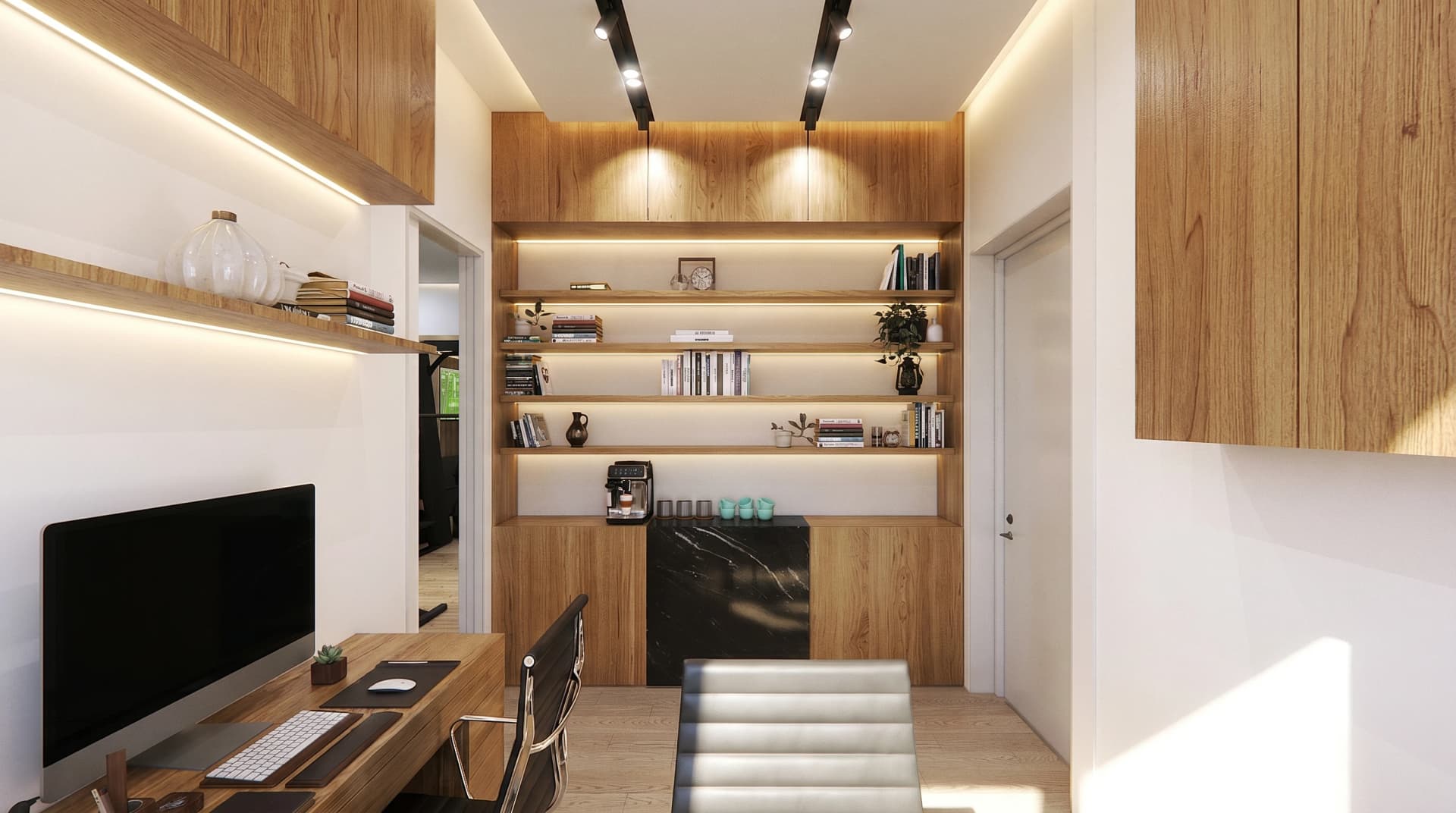
We also separated the office into its own enclosed room. Two reasons: sound separation from the gym (clanking weights are not conducive to a Zoom call), and the existing window on that wall was the most useful natural light source in the whole space — better suited to a desk than to a treadmill.
Phase 3 — Schematic design and outline specifications
Once the program and layout were locked, we developed the schematic design package: an 11-sheet drawing set comprising a cover sheet, interior renderings, the existing floor plan, the proposed floor plan, a reflected ceiling plan, two sheets of interior elevations (looking at every wall in the converted space), and four sheets of outline specifications calling out every material and finish.
Outline specifications are the materials list with enough product-level detail that a builder could begin pricing the project, but without the full technical tolerances, installation methods, and sequencing that would appear in a complete construction document set. For this project the outline specifications named:
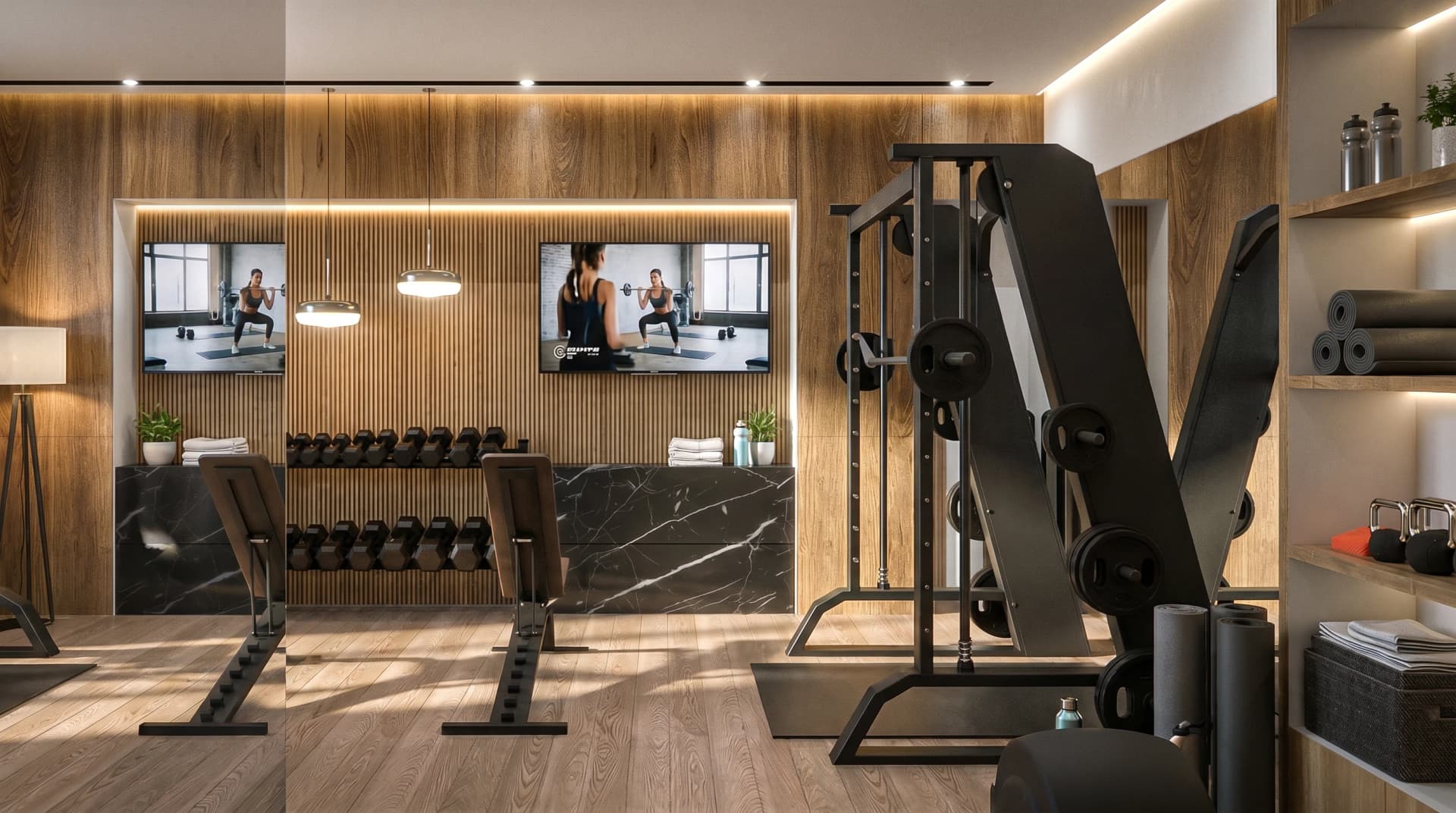
- Gym flooring: oak waterproof rigid vinyl plank, 8 inches by 60 inches — a vinyl product engineered for spaces that see weight drops without subfloor damage
- Office flooring: oak waterproof luxury vinyl plank, 6 inches by 48 inches — a slightly more residential profile for the work area
- Wall finish: acoustic slat oak wood panels — slatted wood that absorbs sound while reading visually as warm and modern
- Cabinetry: custom oak wood cabinets
- Accent material: black marble porcelain slab on a single feature wall behind the weight rack
- Lighting: recessed spot lights, linear cove lighting at the perimeter ceiling, and tape lighting under the cabinets
Outline specifications give the client a clear sense of what the project will feel like in real materials and let the builder generate an early cost estimate. The full specifications — installation method, fastening, transitions, edge treatments, exact tolerances — come later, in the construction documents phase.
The acoustic detail that matters in a home gym
One thing we paid particular attention to in this project, and that most residential renovations skip, is acoustic separation. A home gym next to bedrooms or sharing walls with neighbors is a real problem. Smith machines clang. Dropped weights make a percussive thud that travels through wood framing. A treadmill running at 6 mph generates a low-frequency rumble that bedrooms one wall over will hear at 11 PM.
The outline specifications for this project called out STC-rated wall and ceiling assemblies — Sound Transmission Class is the industry measure of how much sound a wall or ceiling blocks, where higher numbers are better. The wall partition we specified was rated for STC 46 with mineral wool insulation between studs at 24 inches on center; the ceiling assembly used 2x10 wood joists at 16 inches on center with optional sound mat and pad-and-attached carpet flooring above for additional dampening. None of this is exotic — it’s standard commercial-grade construction — but it’s the kind of detail residential design often omits, and a gym is the room where it matters most.
What we delivered — and what we didn’t
It’s worth being explicit about scope. What we delivered for this Newark project was schematic design: the 11-sheet drawing package described above, including renderings, floor plans, elevations, and outline specifications.
What we did not deliver — because schematic design ends before these phases begin — was the full construction document set (the next phase, typically twice the sheet count and many times the technical detail), the permit application package, construction administration, or any role in selecting or coordinating the actual general contractor.
Whether the client moved the project into construction is something we don’t know. Schematic design packages frequently sit on the shelf for months or years before clients commit to construction; sometimes they pivot to a different scope; sometimes they build it exactly as designed; sometimes the project never happens. Our involvement on this one ended at the conceptual drawings.
What this kind of project actually costs
Cost transparency on residential design fees is hard to find — partly because every project is different, and partly because architects are uncomfortable putting numbers in writing without seeing the specific scope. Here are real ranges we typically see for a project this size in the Bay Area, with the explicit caveat that any specific quote depends on conditions we’d need to evaluate first:
- As-built survey: $1,000–$2,000 for a single-room space of this size (this Newark project: $1,500)
- Schematic design: typically $4,000–$10,000 for a roughly 360-square-foot conversion, depending on the level of design exploration the client wants
- Construction documents: typically $8,000–$18,000 for a project this size, depending on whether mechanical, electrical, and plumbing engineering needs to be subcontracted
- Permits and city fees in most Bay Area cities: $1,000–$3,500 for a residential garage conversion to non-habitable accessory use; significantly more if the conversion creates habitable space (an ADU or JADU)
- Construction: $150–$400 per square foot for a finished garage conversion, depending on whether new HVAC, plumbing, and electrical service are required, and on the finish level (this project’s outline specifications were mid-to-high finish)
On a 360-square-foot conversion, that puts the realistic project total — design plus construction plus permits — somewhere between $70,000 on the very modest end and $200,000 or more for a fully built-out, code-compliant non-habitable space. Habitable conversions (ones that create a legal sleeping room) cost more because they trigger more code requirements: insulation thresholds, ventilation, egress windows, smoke and carbon-monoxide alarms, and so on.
Things to consider before starting a garage conversion in California
If you’re considering a similar project, a few practical things worth knowing before you call an architect:
- Permits are required in essentially every California city for converting a garage to occupied space, even if you’re keeping the use “non-habitable” (gym, office, hobby room). Don’t skip the permit — unpermitted conversions are a real headache to unwind at sale.
- There’s a meaningful legal distinction between a non-habitable accessory conversion (gym, office, art studio) and a habitable conversion (an ADU or JADU with a sleeping room). Habitable triggers significantly more code requirements. Decide which you’re doing before design starts; it changes the budget materially.
- Garage slabs slope toward the garage door for drainage. Any conversion to a finished floor needs to address that slope — usually with a self-leveling underlayment or a built-up subfloor. Either adds cost.
- Existing utilities (water heater, electrical panel, gas meter, sometimes a water filter or softener) cluster on whichever wall connects most directly to the main house. Relocating them is expensive enough that most designs work around them, not over them.
- Insulation is usually the largest hidden cost in the construction phase. A garage that was never insulated needs full wall, ceiling, and floor insulation to be comfortable year-round — a meaningful chunk of the construction budget that’s invisible in the final result.
- Acoustic separation from the rest of the house matters more than people realize, especially for gym uses. Plan for it during schematic design; retrofitting it later is much harder.
Sources and further reading
Authoritative resources on the codes and standards referenced above:
Related reading from our blog:
Considering a garage conversion in the Bay Area?
Garage conversions are some of our favorite small projects — the constraint of working in a fixed footprint with a fixed budget tends to produce design clarity that larger projects don’t. If you’re thinking about converting your garage into a home gym, home office, art studio, or accessory living space, we’d be happy to start with a site visit and an as-built survey.