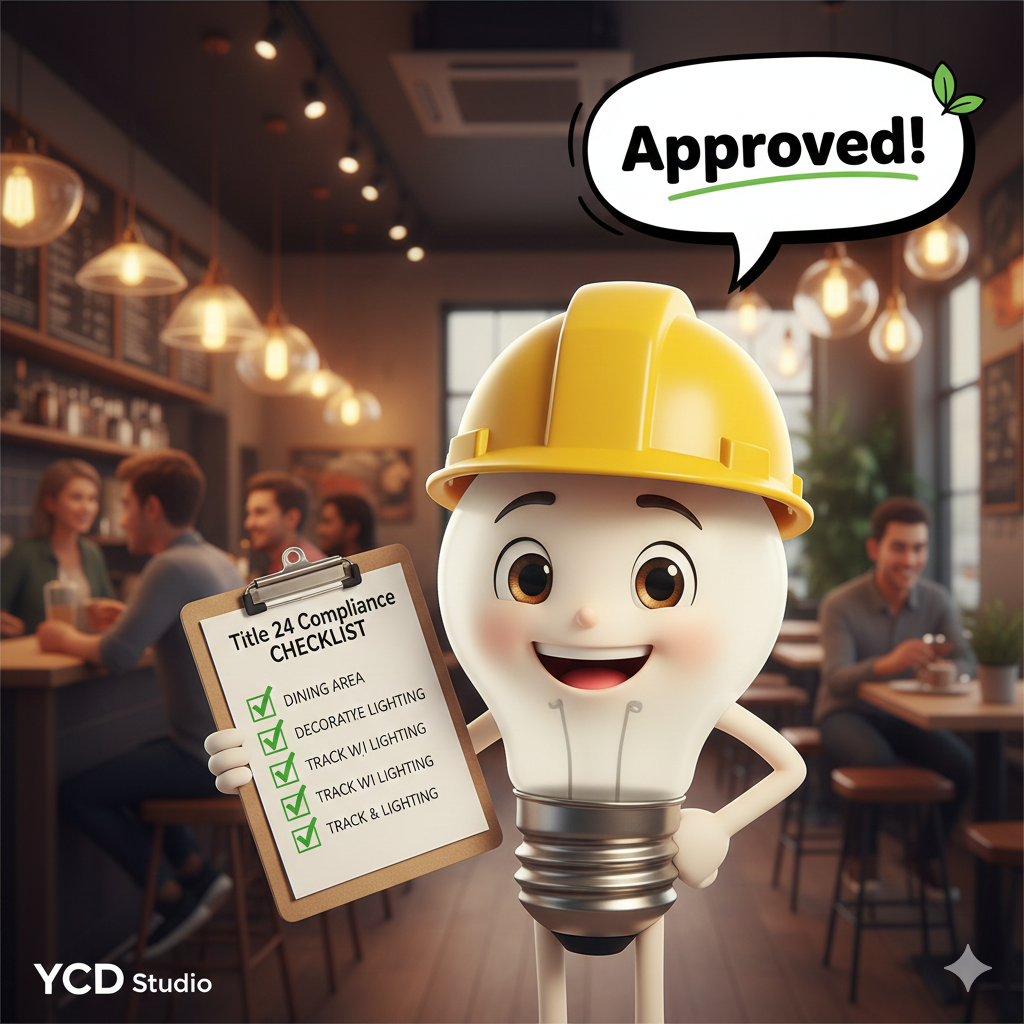
If you are planning a restaurant, café, or retail commercial tenant improvement anywhere in the San Francisco Bay Area, there’s a moment that catches almost everyone off guard. For many Title 24 commercial tenant improvement projects, that moment comes when the City asks for energy compliance during plan check.
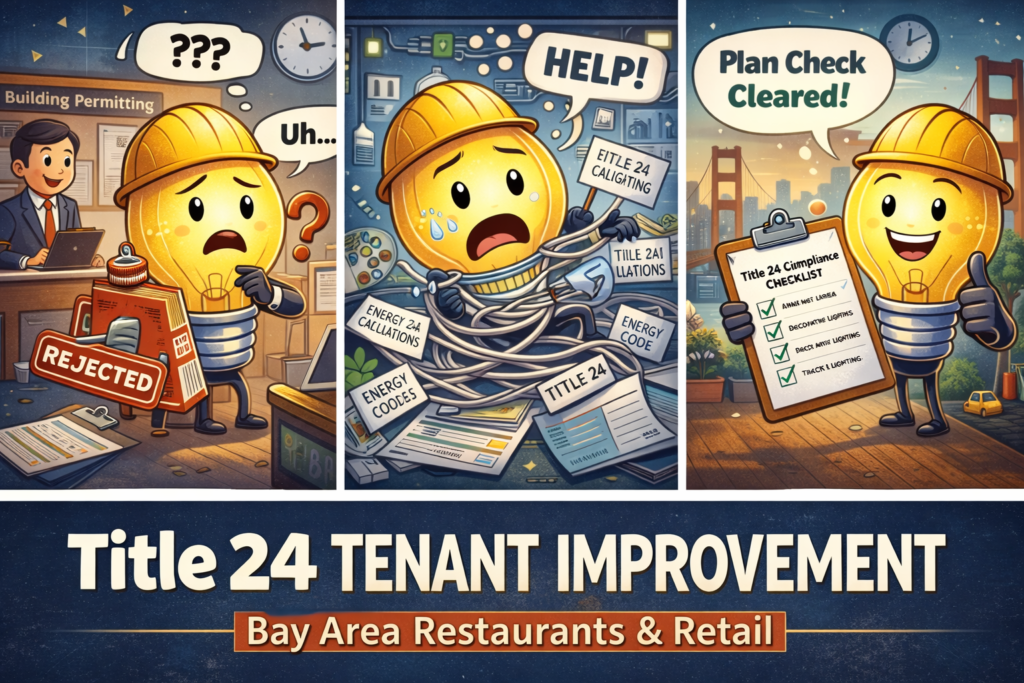
You submit drawings… Plan check comes back… And suddenly the City is asking for energy forms, lighting compliance, or something called Title 24.
Most clients react the same way: “We’re just changing lights… why is this a thing?”
You are not wrong to be confused. Across the San Francisco Bay Area, from San Francisco and Oakland to Walnut Creek, Pleasanton, and everywhere in between, lighting is one of the most strictly regulated parts of any commercial build-out.
First: You Didn’t Do Anything Wrong
When a city asks for lighting or energy documentation, it usually means your project touched lighting in a way that triggers state energy rules. Lighting is highly regulated because it’s one of the most effective ways to reduce energy use at scale across California.
But here’s what the plan check comment doesn’t tell you: your design probably already complies. The issue isn’t that you designed something illegal. It’s that you haven’t provided the official paperwork proving it meets the code.
What Is “Title 24” (Without the Jargon)?
Title 24, Part 6 is California’s Energy Code. For commercial tenant improvements, it ensures your project meets minimum efficiency standards.
It focuses on three things:
Lighting Power Density (LPD): Limits on how much total wattage you can install per square foot. Think of this as your “electrical budget” for lighting.
Lighting Controls: Mandatory requirements for occupancy sensors, dimming, and automatic shut-off timers. The code assumes spaces are often left lit when empty, so it requires automatic controls to prevent waste.
Documentation: Official Certificates of Compliance (NRCC) that must be submitted with your permit application. These are state-mandated forms—not something your local building department invented to make your life harder.
Title 24 Tenant Improvement Requirements in a Real Bay Area Project
Let’s make this concrete with a real scenario:
You’re opening a 2,000 square foot restaurant in Oakland. Your designer specs beautiful pendant lighting over dining tables, decorative wall sconces, and track lighting over the bar to highlight your craft cocktail program.
Your total lighting load: 8,200 watts.
Without Title 24 documentation, here’s what the City sees:
- A bunch of fixtures with no proof they meet energy limits
- Lighting that might exceed the allowed wattage for a restaurant
- No indication of required controls (occupancy sensors, time switches, etc.)
With proper Title 24 documentation, here’s what you show:
- Base lighting allowance for dining area: 4,590 watts (2,000 sf × 0.90 W/sf from Table 140.6-C)
- Additional decorative allowance: 1,400 watts (2,000 sf × 0.70 W/sf for restaurant dining areas)
- Track lighting over bar: 1,800 watts (calculated per code-required method)
- Total allowed: 7,790 watts
Hmm. You’re at 8,200 watts designed vs. 7,790 watts allowed. You’re 410 watts over.
This is where early involvement matters. Before you order fixtures, we catch this, swap two of your highest-wattage pendants for slightly more efficient models, and you clear compliance with 100 watts to spare. Total impact to your design: nearly invisible. Total impact to your timeline: zero.
Compare that to discovering this during plan check when your fixtures are already ordered, your electrician is scheduled, and the City won’t issue your permit until you fix it.
Why Title 24 Tenant Improvement Reviews Are Common in Restaurants and Retail
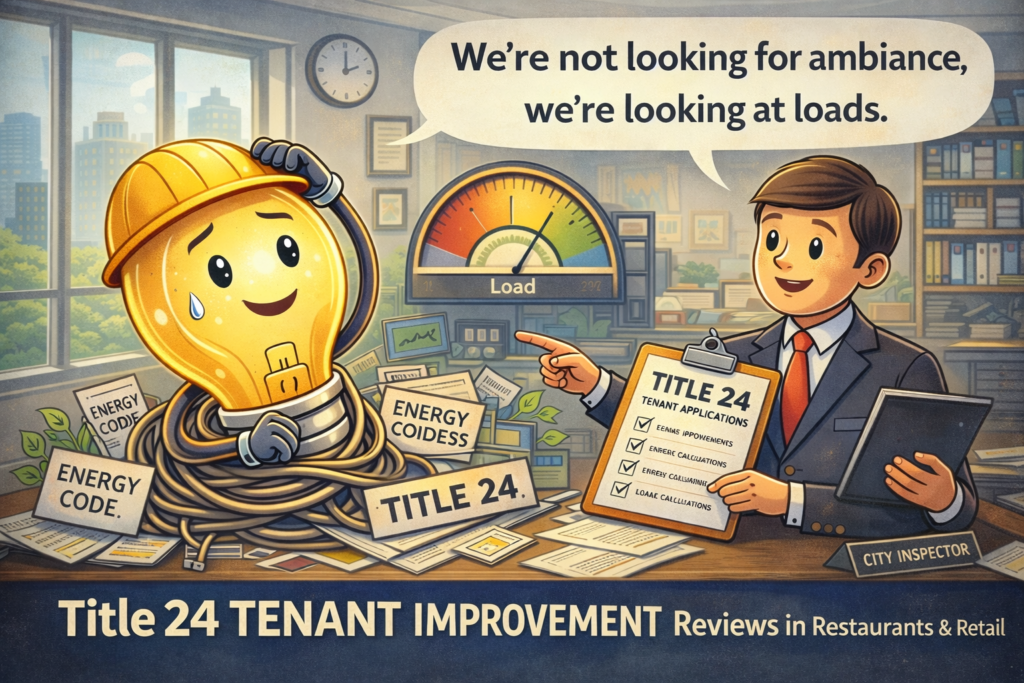
Restaurants and retail spaces use “visual expression” lighting that often pushes the limits of standard allowances. The City doesn’t see “ambiance”; they see potential electrical load that will run for decades.
Common triggers include:
Track Lighting: Under the 2025 Energy Code, track lighting is calculated using the “greater of” rule: either 30 watts per linear foot of track, OR the total rated wattage of all fixtures installed on the track—whichever is higher.
Why? The code assumes track systems can be loaded with more fixtures later, so it defaults to a conservative “capacity” assumption. A current limiter can solve this by physically restricting the system to your designed load, allowing you to use actual installed wattage instead of the 30W/ft default.
Accent & Display Lighting: High-end retail displays and restaurant “feature” pendants fall into special allowance categories. If you don’t know how to claim the “Additional Decorative Allowance” correctly on the state forms, the City will evaluate your project as if those allowances don’t exist—and reject your lighting design even though the code technically allows it.
Lamp-Based Decorative Fixtures: That vintage-style chandelier with Edison bulbs? The code requires you to document it at its maximum rated lamp wattage, not the efficient LED bulbs you plan to install. Why? Because lamps can be swapped later. A 6-lamp chandelier rated for “60W max per socket” gets documented as 360 watts, even if you’re installing 8W LED bulbs.
The Bay Area Permitting Reality
Each jurisdiction in the San Francisco Bay Area has its own process for clearing these “energy” comments:
San Francisco: SF DBI often requires a Final Compliance Letter (also called an Affidavit of Compliance) signed by the designer or energy consultant to clear Title 24 conditions before you can get your final Certificate of Occupancy. This happens after construction is complete but before you can legally occupy the space. Miss this step and your opening day gets delayed even though the physical work is done.
Oakland: For most Oakland commercial tenant improvements, you must submit an Accessibility Checklist (CASp inspection or self-certification) alongside your Title 24 reports to even begin the plan check process. Oakland’s process is front-loaded—they want to see energy compliance at initial submittal, not as a later correction.
Walnut Creek, Pleasanton, Dublin, Danville: Tri-Valley cities generally follow similar state requirements but with varying review timelines and local preferences for documentation format. Each building department has its own rhythm—knowing these local processes prevents unnecessary resubmittals.
Berkeley, Alameda, Emeryville: Each has slight variations, but all enforce the same underlying state energy code. The forms are identical; the submittal process and review timelines vary.
If you’re working with an experienced design team, they’ll understand these local nuances and help you navigate the permit process efficiently.
You can also check out Bay Area Tenant Improvement Design & Permitting Guide | A comprehensive overview of the TI process from concept to Certificate of Occupancy.
A Recent Example: Coffee Shop
A client came to us after a plan check rejected their initial lighting submittal. The comment from the City was frustratingly vague: “Provide Title 24 calcs for proposed lighting.”
The situation:
- They’d specified 12 feet of track lighting over the espresso bar
- Their design included 8 track heads at 12 watts each (96 watts total installed)
- They hadn’t provided any energy documentation
The problem: Without documentation showing otherwise, the City calculated their track at the code default: 12 feet × 30 W/ft = 360 watts—nearly 4× what they were actually installing.
The solution: We stepped in and provided the NRCC-LTI-E form (the official state lighting compliance certificate) with Table G filled out showing the track calculation. We documented both methods:
- Installed wattage: 96W
- Linear foot method: 360W
- Required compliance value: 360W (the “greater of”)
Then we showed that even at 360 watts, their total lighting stayed within the retail Area Category allowances for their 850 sf space.
Total turnaround: 3 days. The permit cleared the next review cycle. The client didn’t need to change a single fixture—they just needed the right paperwork.
Does This Mean More Cost or Delays?
Usually not – if you handle it early. Here’s the difference:
Handled Early (During Design):
- Your architect/designer specs compliant fixtures from the start
- Energy calculations are done before permit submittal
- Plan check clears in one cycle
- You order the right fixtures the first time
- Typical cost: $800–1,500 for compliance documentation
- Timeline impact: zero
Discovered Late (During Plan Check):
- You may need to swap fixtures already ordered
- Permit review stops until you provide documentation
- You’re paying holding costs on your lease while waiting for permit clearance
- Your contractor’s schedule gets pushed
- Construction timeline slips 2–4 weeks minimum
- Typical cost: $2,500–4,000 in redesign, restocking fees, and delay costs
- Timeline impact: could delay your opening
The documentation itself isn’t expensive. The surprise is.
Most of our restaurant and retail clients spend between $1,200–$2,000 on Title 24 compliance documentation as part of their overall permit set. That’s typically 3–5% of the total architectural/engineering fees for a commercial tenant improvement.
Compare that to the cost of a delayed opening: Even one week of delay on a restaurant lease in San Francisco or Oakland can cost $3,000–$8,000 in rent, plus lost opening-week revenue that you’ll never recover.

Not Sure If Your Title 24 Tenant Improvement Will Trigger Review?
If your scope includes any of the following, you’ll almost certainly need energy documentation:
- ✓ Replacing or adding more than 10 light fixtures
- ✓ Installing any track or rail lighting systems
- ✓ Adding decorative pendants, chandeliers, or accent lighting
- ✓ Changing lighting controls, switches, or adding dimmers
- ✓ Any work that requires an electrical permit for lighting
Here’s what typically does NOT trigger full Title 24 review:
- Replacing burned-out lamps/bulbs (maintenance)
- One-for-one fixture replacement of 10 or fewer fixtures per year (limited alteration exception)
- Replacing ballasts or drivers inside existing fixtures
The line between “alteration” and “maintenance” is where most confusion happens. When in doubt, assume you’ll need documentation—it’s better to prepare early than scramble during plan check.
The Takeaway: Anticipate, Don’t React
At YCD Studio, we handle these “behind-the-scenes” items so our clients don’t have to learn energy code from scratch during an already stressful build-out process.
We anticipate when your lighting design will trigger an energy review and document it correctly the first time to avoid unnecessary back-and-forth with the City. Our approach:
- Review your lighting design early (ideally during Schematic Design or early Design Development)
- Flag potential compliance issues before you order fixtures
- Provide official NRCC forms as part of your permit submittal package
- Coordinate with your electrician to ensure installed controls match documentation
- Handle final compliance letters needed for Certificate of Occupancy
You focus on creating an amazing space. We focus on making sure the City says yes.
Dealing with a Confusing Plan Check Comment?
Whether you are launching a new restaurant in Walnut Creek, a boutique in San Francisco, or a café in Pleasanton, we can help you navigate the permits and codes to open on time.
Schedule a Consultation Call with YCD Studio Today
New to commercial tenant improvements?
Check out these guides:
Commercial Tenant Improvements: 10 Questions for Your Lease | Understanding your lease obligations before you start design can save thousands in unexpected costs.
Bay Area Tenant Improvement Design & Permitting Guide | A comprehensive overview of the TI process from concept to Certificate of Occupancy.